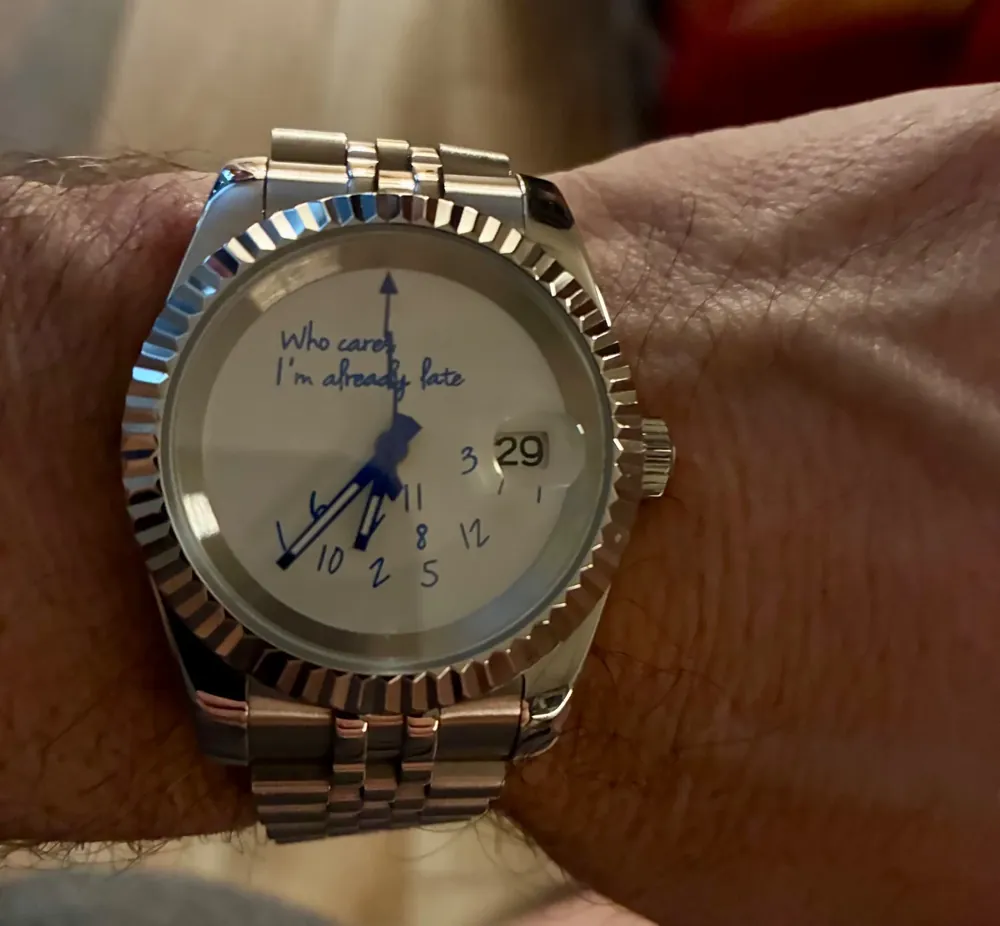
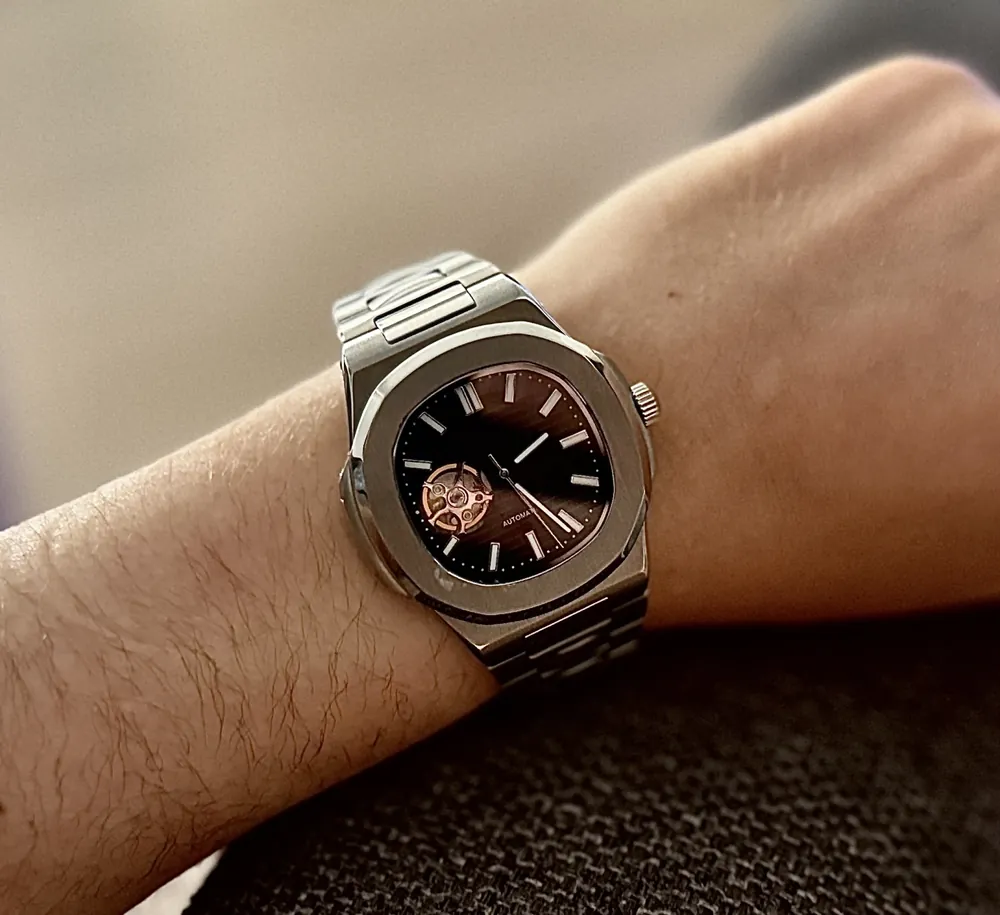
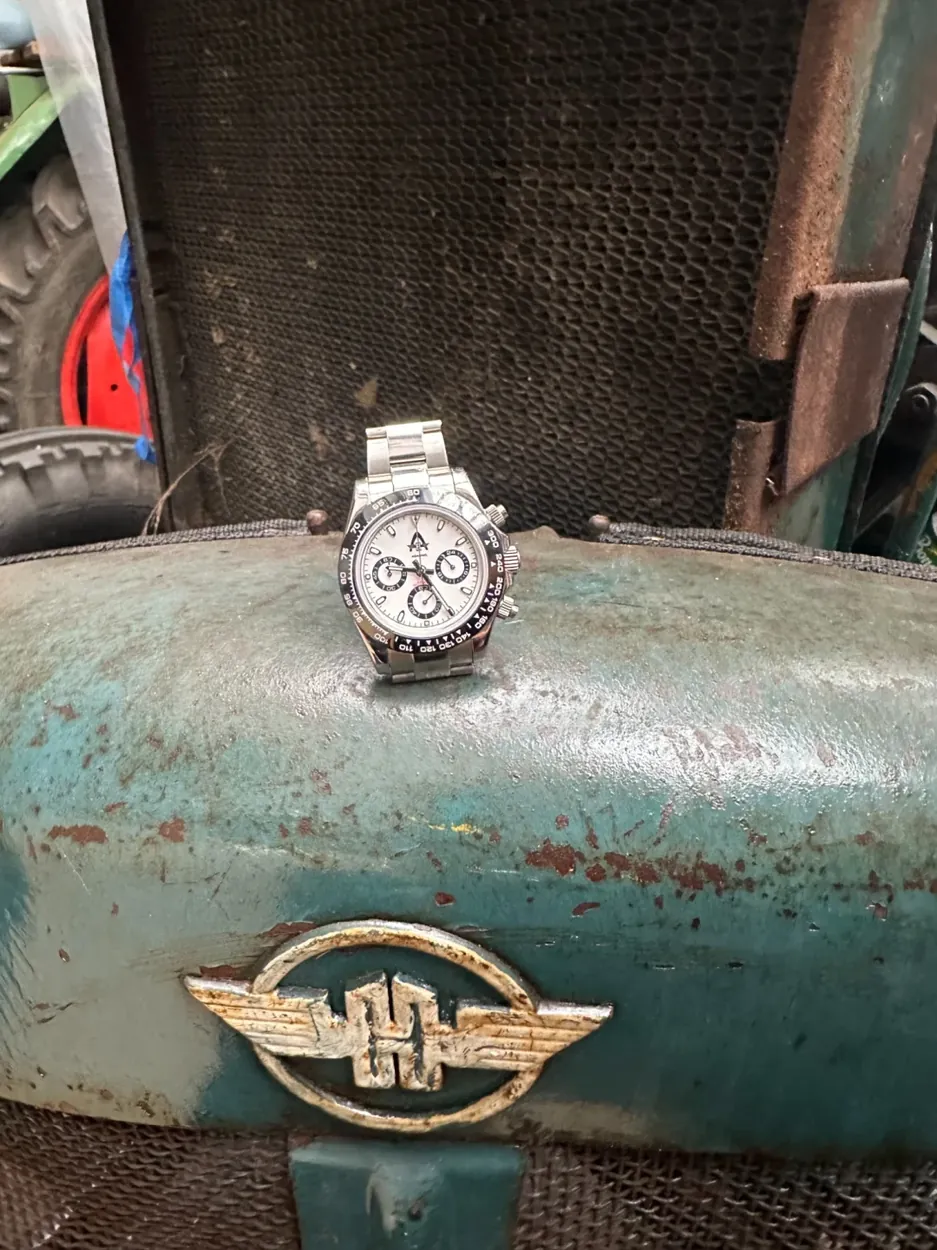
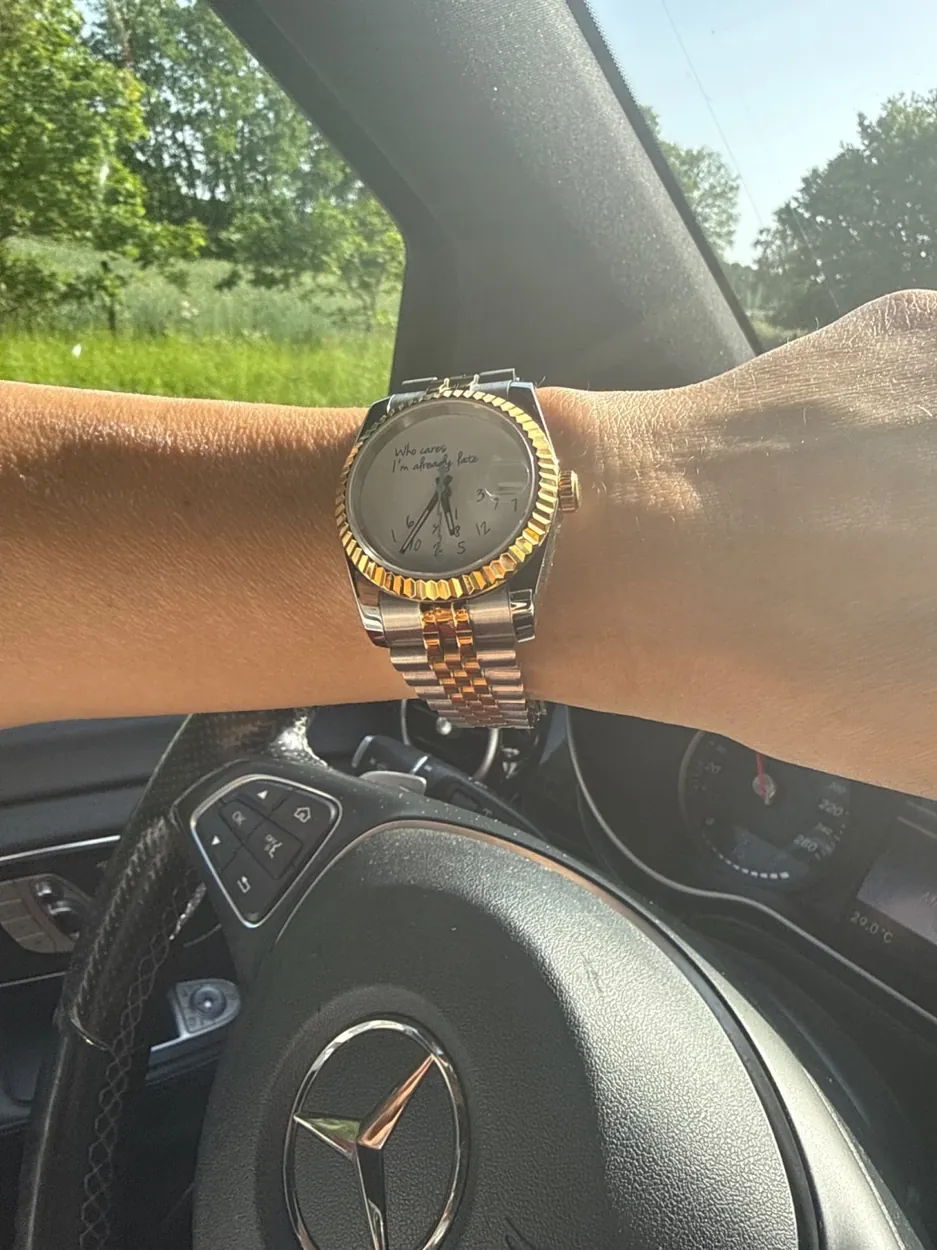
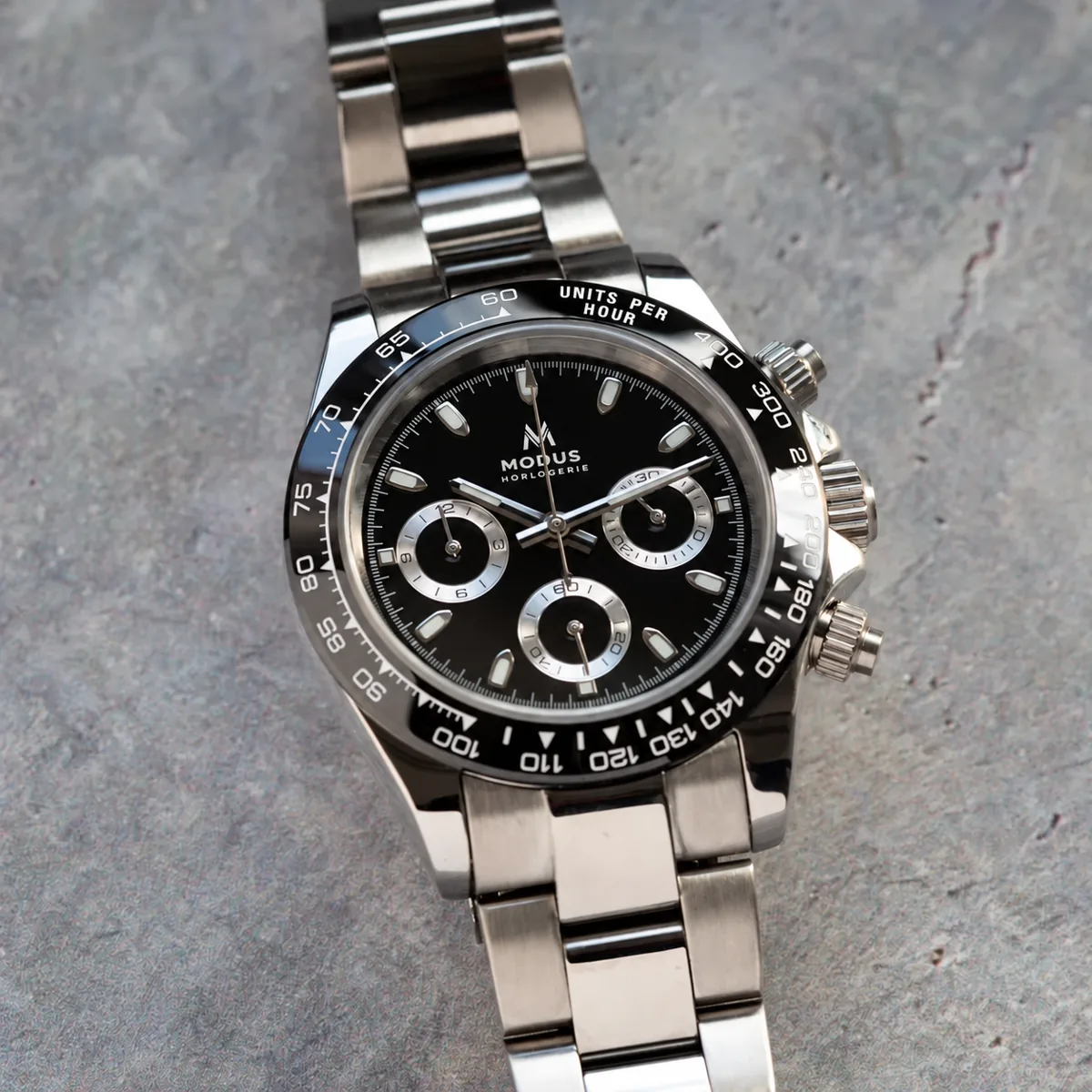
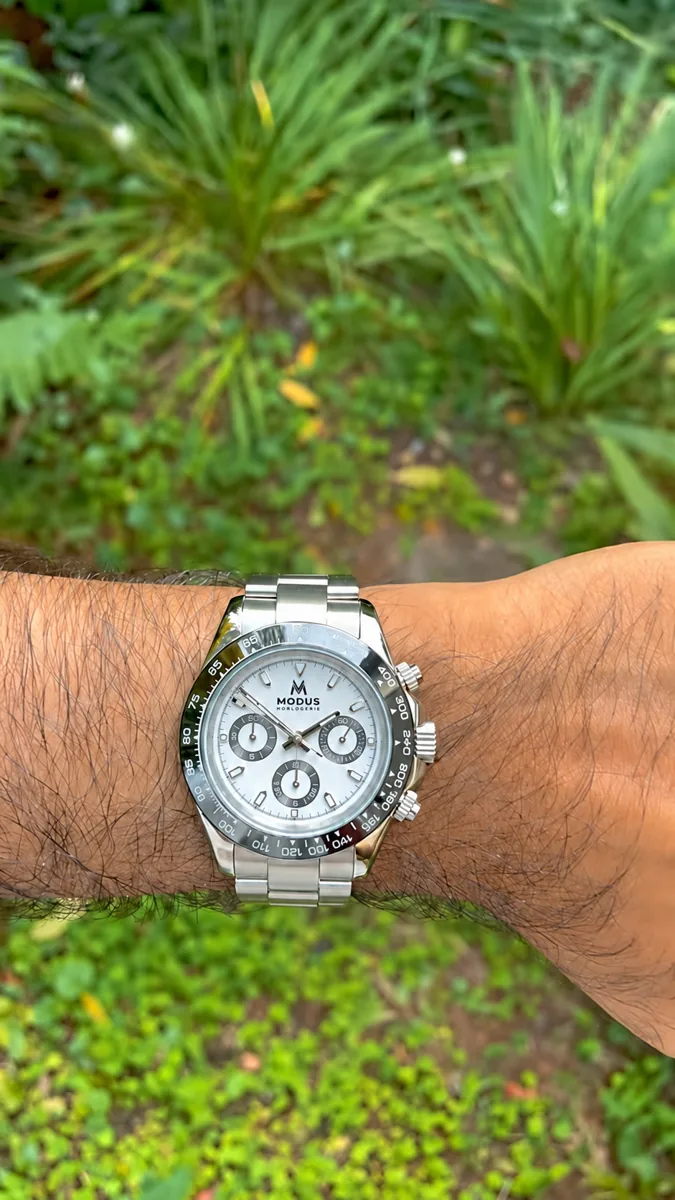
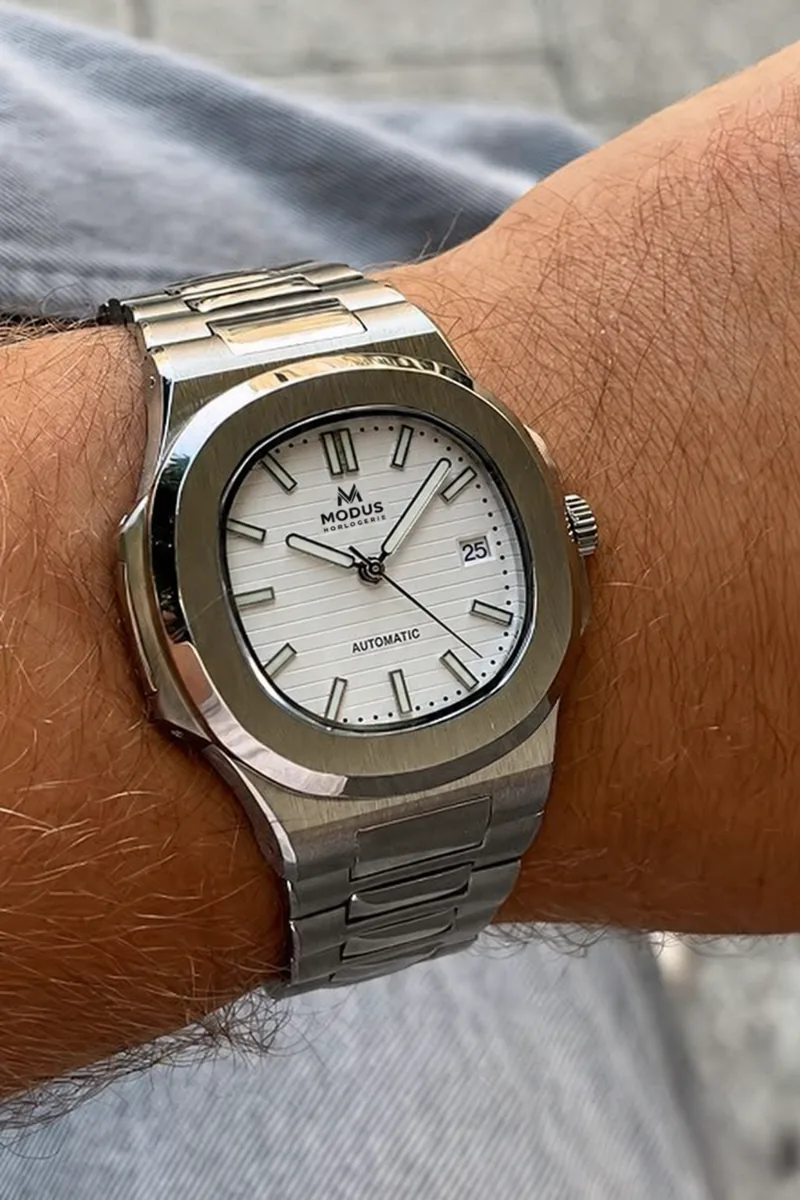
A seiko mod kit is a set of matching watch parts built around an automatic movement, most often the Seiko Instruments NH35: case, dial, hands, crown, crystal and strap. Putting it together takes a hand press, a case opener, a dust blower and about an hour of patience. A careful beginner can do it, but three things decide the result: dust under the crystal, how the hands are set, and water resistance, which nobody can confirm without a pressure tester. If you want the look without the assembly, the Modus configurator lets you choose every part and delivers the watch assembled, from €349.
What a complete seiko mod kit contains
A complete kit has seven items. Check that all of them are made for the same movement: a mismatch is the first reason a build fails.
- The movement: NH35 for a three-hand automatic with date, NH36 if you also want the day, NH38 with no date, NH34 for a GMT. All four are made by Seiko Instruments.
- The case: machined for that movement, with the right movement holder. Look at the crown position: 3 o'clock or 4 o'clock.
- The dial: its diameter (often 28.5 mm for NH35 cases) and the position of its feet must match the case and the crown. A dial made for a 4 o'clock crown will not line up with a crown at 3.
- The hands: on an NH35 the standard hole sizes are 1.50 mm for the hour hand, 0.90 mm for the minute hand and 0.20 mm for the seconds hand.
- The crown and stem, usually supplied with the case.
- The crystal: sapphire if you can, with its gasket.
- The strap or bracelet and its spring bars, in the lug width of the case.
To see what each part does, read what a seiko mod is and our NH35 movement guide.
The tools you need
- A hand press, or at least a good set of hand-setting tools.
- A case opener that fits the caseback (a wrench for a screw-down back, a knife for a snap-on one).
- Tweezers, a movement holder and an anti-static mat.
- A dust blower, finger cots or gloves, and a loupe.
- A spring bar tool for the strap.
Entry-level tools cost a few tens of euros. Cheap ones show quickly: a press that slips marks the dial, a loose case opener scratches the caseback.
The four assembly steps
1. Prepare the movement
Release the stem by pressing the small lever on the movement, then remove the original dial ring if there is one. Work on a clean surface, under a low side light, away from any draught.
2. Fit the dial
The dial feet slot into the movement. A dial without feet is held with adhesive dial dots. Check straight away that the date sits squarely in its window.
3. Set the hands
This is the step that needs the most care. Turn the crown until the date flips, which is midnight. Set the hour hand exactly on 12, then the minute hand on 12, then the seconds hand. Press straight down, without force. A hand pushed too far rubs on the one below and stops the watch.
4. Case up and close
Seat the movement in its holder, lower it into the case, refit the stem and crown, then screw the caseback down on a clean, lightly greased gasket. Blow every surface before you close: a speck of dust under the crystal stays visible for the life of the watch.
What a home build cannot guarantee
- Water resistance. Without a pressure tester, nothing tells you the gaskets seal. Keep the watch away from water until it has been tested.
- Accuracy. A new NH35 runs between −20 and +40 seconds a day according to the manufacturer. Fine regulation takes a timing machine and experience.
- Warranty. At best each part has its own warranty. The assembly has none: if the watch stops, finding out why is your job.
- The real cost. Add up quality parts, a sapphire crystal and the tools, and a first build often costs as much as an assembled watch, without the after-sales service.
- Other brands' names. A dial or crown carrying another brand's name or logo can be a counterfeit part, even on a watch you build for yourself. Choose unbranded parts, or parts with your own name.
Build it yourself, or have it built
A kit is the right choice if the pleasure is in the building: you learn how a watch works and you keep the pride of having made it. If what matters is the watch on your wrist, an assembled one avoids every trap above.
At Modus Horlogerie there are two ways to get one:
- The configurator: you choose the case, dial, hands, bezel and strap, exactly as you would with a kit, and you receive the watch assembled. From €349, delivered in 7 to 9 days, delivery included. A name or initials on the dial are included in the price.
- Ready-to-wear seiko mods: finished watches from the collection, from €295 (€329 for the ORBIT skeleton, €339 for the MERIDIAN GMT), shipped from stock.
Either way: sapphire crystal, 5 ATM water resistance, a 3-year warranty and free delivery. You have 30 days to return the watch; return shipping is at your expense unless the watch is faulty.
Prices checked on modus-horlogerie.fr on 22 November 2026.
Frequently asked questions
Do you need to be a watchmaker to build a seiko mod?
No. A careful beginner manages with the right tools. Setting the hands and keeping everything clean take patience, not training.
Which movement should a first kit use?
The Seiko NH35. It is sturdy and widespread, and most cases, dials and hands on the market are made for it.
Is a seiko mod kit cheaper than an assembled seiko mod?
Not always. With quality parts, a sapphire crystal and the tools, a first build often costs about as much as an assembled watch, with no warranty on the assembly. A kit pays off from the second watch, once you own the tools.
Can you swim with a watch you built yourself?
Not without a pressure test. Even with new gaskets, only a tester confirms that the watch holds its stated rating.
Does a complete kit include everything?
For the parts, yes, if it has the seven items listed above, all made for the same movement. The tools are almost always sold separately, and no kit replaces the pressure test.
Does Modus sell seiko mod kits?
No. Modus sells assembled watches, from the collection or designed in the configurator, with a 3-year warranty.